Start by accepting the real constraint
If you are building healthcare AI, begin by accepting where the constraint actually sits. It is no longer intelligence. The technology mostly works. It drafts the clinical note, summarizes the literature, flags the coding error, and answers the patient question at two in the morning. The constraint is trust, and the data shows it plainly.
Roughly fifty-two percent of patients now use AI to research their own conditions, and about seventy-four percent say they trust the answers it gives them. Yet seventy-eight percent still expect a clinician to validate anything it produces, and seventy-seven percent of clinicians re-check AI outputs themselves, wary of bias, hallucination, and missing context. People lean on the technology and brace against it at the same time.
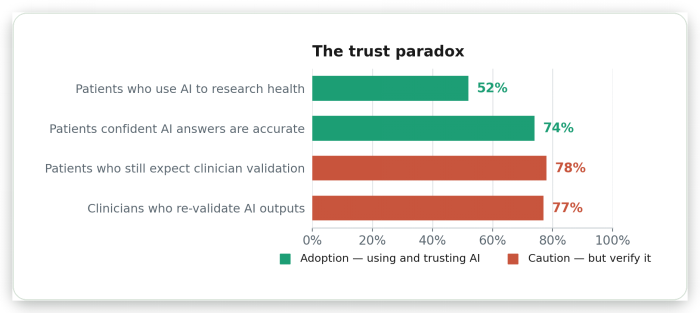
Figure 1. Adoption and caution rise together: people increasingly use AI and increasingly insist it be verified. Source: Wolters Kluwer 2026 Future Ready Healthcare survey.
An AI tool a clinician has to re-validate on every use has not saved them time. It has only moved the work from producing the answer to policing it. So the practical question for any builder is not how to make the model more capable. It is how to make the system trusted enough to rely on. Everything that follows is how.
Know what you are building
Trust is not a mood that good marketing produces. In a clinical system it is an engineered property, assembled from specific layers you can point to and build.
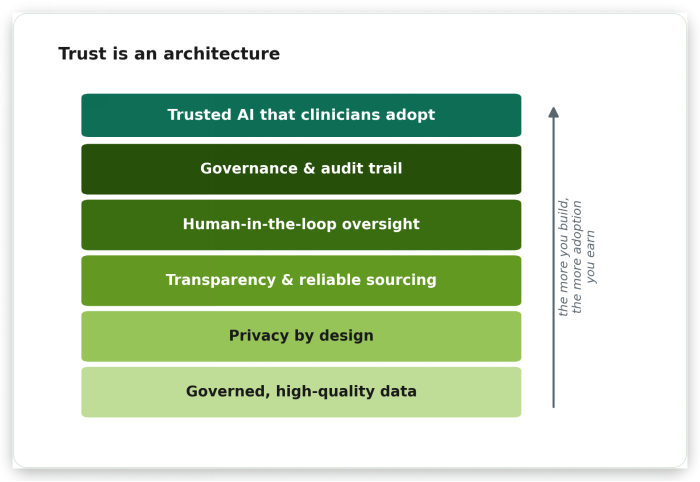
Figure 2. Trust in a clinical AI system is built bottom-up. Each layer is a deliberate engineering decision, not an afterthought.
It starts with a governed, high-quality data foundation, because a model pointed at fragmented data inherits every flaw beneath it. On that sits privacy by design, protection built into the architecture rather than bolted on to satisfy an audit. Above that, transparency and reliable sourcing, so a clinician can see why the system said what it said and where the answer came from. Then human oversight placed where judgment actually matters, not as digital busywork. And wrapping all of it, governance and an audit trail that make every action reviewable and every actor accountable.
Build those layers and trust becomes an output of the system rather than a hope pinned to it. That is the target. The harder question is how you reach it without stalling, and that is not an architecture problem. It is a delivery problem.
Build it the way you build trust: iteratively
Here is the mistake that sends most healthcare AI into the pilot graveyard. Teams try to build the entire trust architecture, validate it once, and launch. That is big-bang delivery, and big-bang delivery is precisely how trust is lost. Clinicians do not grant trust to a finished system handed down to them. They grant it to a system they have watched earn it, one reliable release at a time.
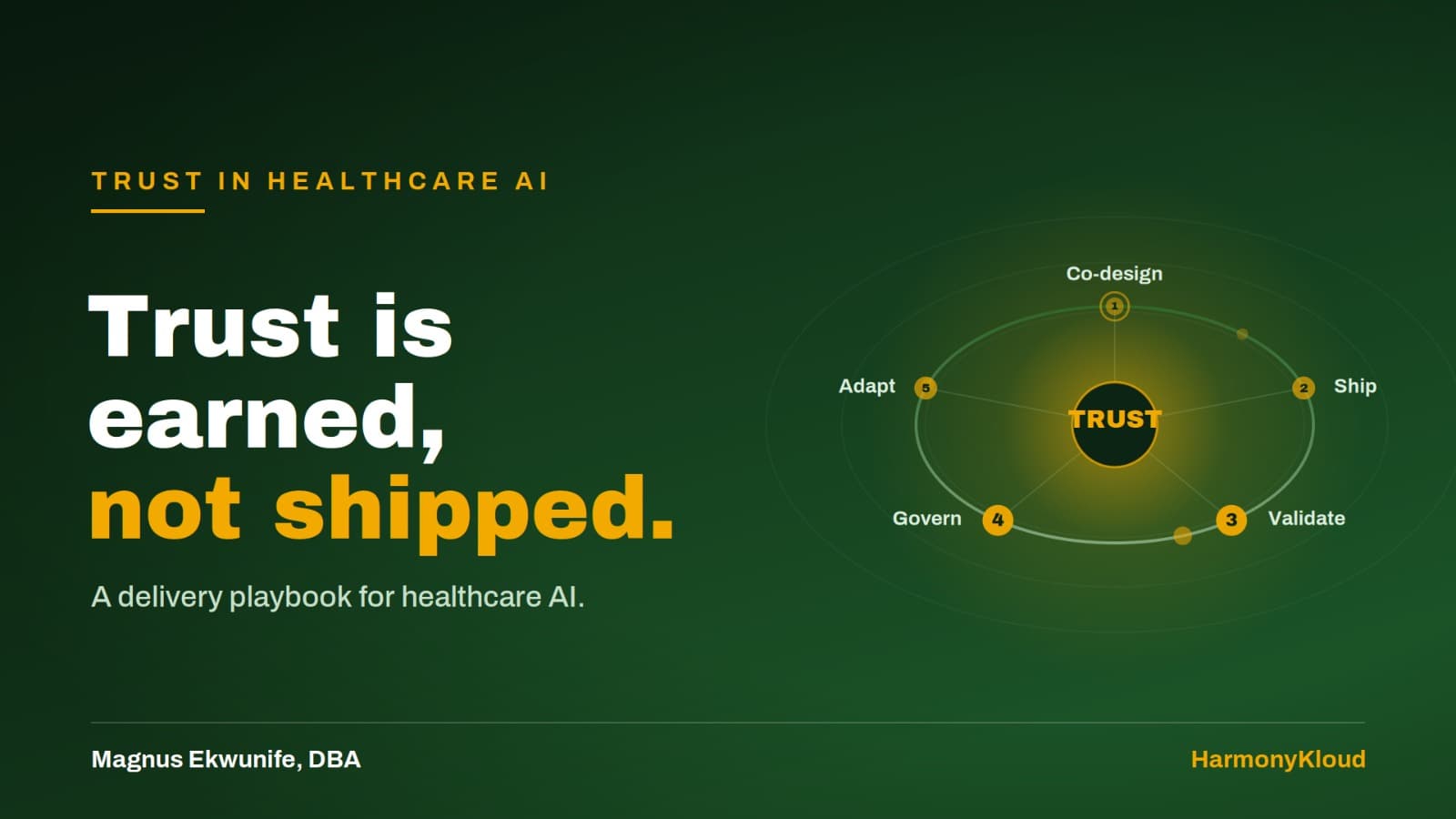
So build trust the way good software is delivered: iteratively, with the clinician in the loop. The pattern is a loop, and it has five moves.
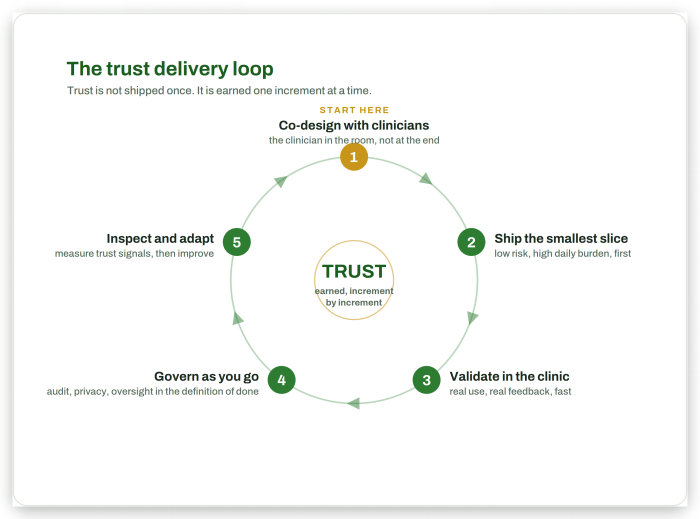
Figure 3. The trust delivery loop. Each turn earns a little more trust and informs the next increment.
Co-design with clinicians. Put a practicing clinician in the room from the first schema, not in a review at the end. They are the product owner for trust, the proxy for everyone who will have to rely on the system on a Tuesday afternoon.
Ship the smallest trustworthy slice. Do not start with the most dramatic clinical use case. Start where the daily burden is heavy and the clinical risk is low, and deliver one slice that works completely rather than ten that work in a demo.
Validate in the clinic. Put the slice in front of real users inside the real workflow and watch what happens. Trust is confirmed or denied in use, never in a slide deck.
Govern as you go. Build audit, privacy, and oversight into the definition of done for every increment, so governance is never a phase you bolt on later under pressure.
Inspect and adapt. Measure the signals that actually reflect trust: adoption, how often clinicians override or re-check the output, and their stated confidence. Then improve the next increment against what you learned.
Run that loop, and the trust architecture from the previous section gets built the only way it can hold, layer by layer, increment by increment, with the people who must trust it watching it earn that trust. This is the same discipline behind any serious agile delivery. The difference in healthcare is that the customer in the loop is a clinician, and the cost of breaking trust is measured in care.
Choose your first increments well
The loop only compounds trust if your earliest increments are chosen well, and the rule is simple. Begin where clinical risk is low and administrative burden is high, and let each safe win buy the credibility the next, higher-stakes increment will need.
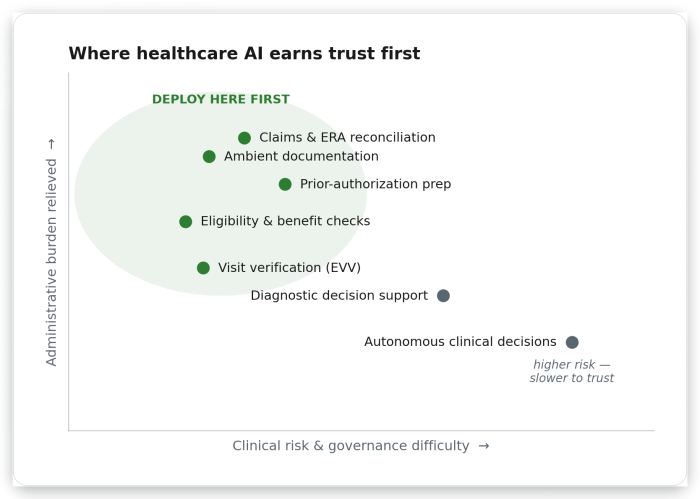
Figure 4. The earliest, safest wins cluster where clinical risk is low and administrative relief is high: documentation, eligibility, prior authorization, claims, and visit verification.
This is why ambient documentation has spread faster than almost any other clinical AI. It relieves a genuine, daily burden at relatively low risk, and the evidence holds up. A multi-site study published in JAMA Network Open found that within thirty days, an ambient AI scribe cut the share of clinicians reporting burnout from about fifty-two percent to thirty-nine percent, with parallel gains in cognitive load and time spent with patients. Eligibility checks, prior-authorization preparation, claims reconciliation, and visit verification all sit in the same fertile zone: high relief, low risk, fast trust. Autonomous clinical decisions sit at the far end of the curve, where governance, liability, and clinician confidence still have a great deal of catching up to do.
What building one taught me
I came to this the slow way, by building a compliance-driven digital-health platform and finding that almost every hard decision was, underneath, a decision about trust, and that the only way to build it was iteratively. We did not design the platform for clinicians. We designed it with them, with practicing behaviour analysts in the room shaping the workflow rather than reviewing it at the end. We made privacy a design constraint from the first schema. We kept a complete audit trail, not because a regulator demanded it, but because accountability is what lets a clinician rely on the system. And we pointed the AI at the administrative load, claims, verification, and compliance checks, rather than at clinical judgment, because that is where the burden is heavy, the risk is contained, and trust is won early.
None of those were choices about a cleverer algorithm. They were choices about delivering a system a busy clinician could believe in, one release at a time.
The trust dividend
The next phase of healthcare AI will not be won by whoever has the most capable model. It will be won by whoever builds the most trusted system, because trust is what converts a promising demo into daily, dependable use, and daily use is where value finally compounds. The capability race is largely over. The trust race is just beginning.
And it rewards a particular kind of builder, not the one with the biggest model, but the most disciplined one, who treats trust as something to be architected layer by layer and earned increment by increment. In healthcare, the technology that wins is the technology people believe in. Everything else is still stuck in the pilot.
Magnus Ekwunife, DBA, is co-founder of HarmonyKloud. A SAFe Practice Consultant with 25+ years leading enterprise technology delivery, he is also adjunct faculty teaching project management, Agile, and technology innovation. His doctoral research examined how technology leaders shape the adoption decisions of the organizations they serve.
References
1. Wolters Kluwer. (2026). 2026 Future Ready Healthcare Survey Report. https://www.wolterskluwer.com/en/know/future-ready-healthcare
2. Samios, G. / Wolters Kluwer. (2026). 2026 Future Ready Healthcare: How AI Is Reshaping the Care Experience. https://www.wolterskluwer.com/en/expert-insights/2026-future-ready-healthcare
3. American Medical Association. (2026). 2026 Physician Survey on Augmented Intelligence. https://www.ama-assn.org/practice-management/digital-health/physician-survey-augmented-intelligence
4. Olson, K. D., et al. (2025). Use of Ambient AI Scribes to Reduce Administrative Burden and Professional Burnout. JAMA Network Open. https://pmc.ncbi.nlm.nih.gov/articles/PMC12492056/
5. ScienceSoft. (2026). Q1 2026 Healthcare AI Trends. https://www.scnsoft.com/healthcare/healthcare-ai-trends
6. HIT Consultant / Cloudera. (2026). Why 80% of Healthcare AI Projects Fail to Scale. https://hitconsultant.net/2026/02/16/cloudera-life-sciences-ai-scalability-pilot-failure-roi/
7. Velosio. (2026). Pilot Purgatory: Why AI Initiatives Fail to Reach Production. https://www.velosio.com/blog/pilot-purgatory-why-ai-initiatives-fail-to-reach-production/
8. QueryNow. (2026). 83 Percent of AI Pilots Fail from Change Management. https://www.querynow.com/blog/ai-pilot-failure-change-management-fix-432606