Twenty-five years on, the real test arrives
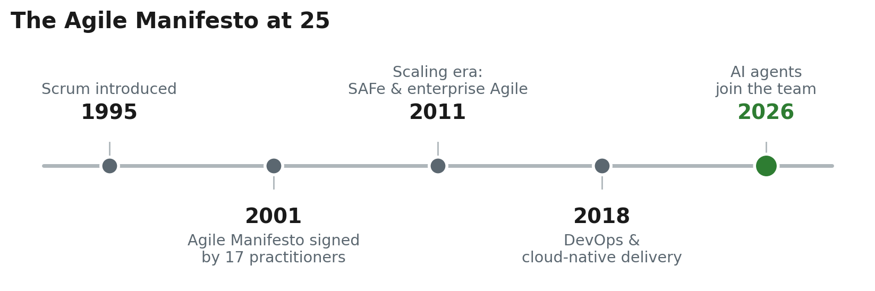
In February 2001, seventeen software practitioners met at a ski lodge in Utah and wrote four sentences that reshaped how the world builds software. The Manifesto for Agile Software Development was a reaction against rigid, documentation-heavy process. It was a bet that people, working software, collaboration, and adaptability mattered more than plans and paperwork. Twenty-five years later, that bet has won so completely that “Agile” is simply how most teams say they work.
The anniversary arrives at an awkward moment, though. For the first time, the team is no longer entirely human. Agentic AI is moving from passive assistant to active teammate that collaborates, architects, and executes across the software development lifecycle. The industry is openly re-examining its foundational text. Thoughtworks marked the anniversary with a retreat on the future of software development, framing the moment as a need to rethink practices and roles while staying grounded in the human-centered values that made Agile transformative.
So the question hangs in the air at every standup: does Agile still mean anything when your teammate is a model? I think it means more than ever, but only if we are honest about what we mistook it for.
What we mistook for Agile
Somewhere across twenty-five years, Agile calcified. What began as a philosophy hardened into ceremonies, story points, burndown charts, velocity, and the daily theater of status updates. For a lot of teams, “doing Agile” came to mean performing the rituals. The certificate, the ceremony, and the board became the scaffolding around the work rather than the work itself. The market has noticed: it is visibly devaluing “basic Scrum,” the mechanical version of the role that mostly administers process.
This matters now because AI is extraordinarily good at exactly that scaffolding. It can chase status, take the notes, generate the report, update the board, and draft the plan. If your practice of Agile was mostly mechanics, AI will quietly make it redundant. If your practice of Agile was about people learning faster than the competition, AI is about to make it far more powerful. The anniversary is forcing a question the certificates never did: which one were you really doing?
Re-reading the four values in the age of agents
Read the four values again with AI in the room, and the alignment is striking: the machine lands on one side of each value, and the human work lands squarely on the other. AI gravitates to the processes, the documentation, the pattern-finding, and the re-planning. What it cannot do is the thing each value prized.
The value | What AI now handles | What stays human |
|---|---|---|
Individuals and interactions over processes and tools | Runs the processes and tooling: boards, status, reporting | The interactions: trust, facilitation, the hard conversations |
Working software over comprehensive documentation | Generates documentation, first-draft code, and tests | Judging what “working” and “valuable” actually mean |
Customer collaboration over contract negotiation | Summarizes feedback and surfaces patterns at scale | The relationship, and the judgment calls only people can make |
Responding to change over following a plan | Predicts bottlenecks and re-plans the backlog on the fly | Deciding which changes matter, and why |
The pattern repeats across all four. Every value was written as a preference: this over that. AI is becoming superb at the “that,” the processes and tools and documentation the authors deliberately ranked second. The “this” (individuals, working outcomes, collaboration, responsiveness) was always the human half. Far from making the Manifesto obsolete, AI is enforcing it, automating what the authors told us mattered less and leaving us to concentrate on what they said mattered most.
What the machines take, and what they hand back
In practical terms, this is a reallocation of where a team’s human leadership spends its hours. The credible voices in the field converge on the same split. AI takes over the low-leverage work (status chasing, basic notes, routine reporting), and in doing so it increases the need for human influence, decision facilitation, and organizational change. The Scrum Master is not being replaced; the role is shifting from process guardian to human-dynamics expert, often working across several teams at once.
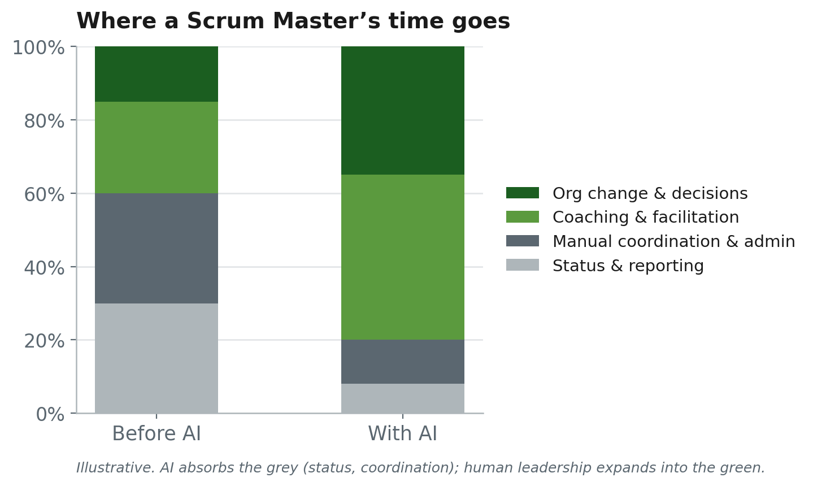
This is why the anniversary is good news for the best practitioners and uncomfortable for the rest. The coach whose value was administering ceremonies finds that a tool now does it faster. The coach whose value was facilitating hard conversations, surfacing disagreement, and guiding a team through a genuinely difficult decision finds that AI has just handed them back the hours to do more of it. Automation does not flatten the role; it raises the bar on it.
The new hard problem: defining “done” for probabilistic software
There is a deeper shift that the ceremonies debate misses entirely. For twenty-five years, “working software” meant deterministic software: given the same input, it produced the same output, and you tested against that certainty. AI features are not like that. They are probabilistic. The same prompt can yield different answers, and “correct” becomes a distribution rather than a fact.
There is a deeper shift that the ceremonies debate misses entirely. For twenty-five years, “working software” meant deterministic software: given the same input, it produced the same output, and you tested against that certainty. AI features are not like that. They are probabilistic. The same prompt can yield different answers, and “correct” becomes a distribution rather than a fact.
A caution: Agile’s own tools can become surveillance
There is a real risk hiding in all this capability. The same AI that forecasts velocity and flags bottlenecks can slide, almost imperceptibly, into monitoring: measuring individuals, ranking them, turning a team’s working agreements into a dashboard someone uses to watch them. That corrodes the exact thing Agile depends on, the psychological safety that lets people admit a task is stuck, an estimate was wrong, or an idea failed.
There is a real risk hiding in all this capability. The same AI that forecasts velocity and flags bottlenecks can slide, almost imperceptibly, into monitoring: measuring individuals, ranking them, turning a team’s working agreements into a dashboard someone uses to watch them. That corrodes the exact thing Agile depends on, the psychological safety that lets people admit a task is stuck, an estimate was wrong, or an idea failed.
What building with a hybrid team taught me
I lead delivery on a healthcare platform built by exactly this kind of hybrid team, and the lessons have been concrete. We let AI do the scaffolding (boilerplate, test scaffolds, first drafts, routine reporting), and the velocity is real. But every decision that carries clinical or compliance weight stays with a human, and AI output is reviewed, not trusted on sight. “Valuable” is defined by clinicians and real workflows, not by a model’s confidence. And we spend the hours AI gives back on the human work: alignment, hard trade-offs, and helping people make good decisions quickly.
None of that is a departure from Agile. It is the Manifesto, applied honestly to a team that now includes machines: keep the humans on the interactions, the judgment, and the change; let the agents carry the process. The framework did not need replacing. It needed remembering.
The Manifesto’s second quarter-century
Agile is not being retired by AI. It is being clarified by it. For twenty-five years we could get away with confusing the rituals for the values, because the rituals were where the work showed up. Now a machine can perform the rituals, and what is left is precisely what the seventeen authors put first: people, working outcomes, collaboration, and the courage to respond to change.
The teams that win the next twenty-five years will pair automated mechanics with deeply human leadership, and they will know the difference. That has always been the harder, more valuable skill. The anniversary, and the machines, are simply making it impossible to fake.
Magnus Ekwunife, DBA, is co-founder of HarmonyKloud. A Safe Practice Consultant with 25+ years leading enterprise technology delivery, he is also adjunct faculty teaching project management, Agile, and technology innovation. His doctoral research examined how technology leaders shape the adoption decisions of the organizations they serve.
References
- 1. Beck, K. et al. (2001). Manifesto for Agile Software Development. https://agilemanifesto.org/
- 2. Thoughtworks. (2026). Thoughtworks Marks 25th Anniversary of the Agile Manifesto with Future of Software Development Retreat. https://www.thoughtworks.com/about-us/news/2026/future-of-software-development-retreat
- 3. Cohn, M. / Mountain Goat Software. (2025). AI Doesn’t Eliminate Agile Teams; It Increases the Need for Great Ones. https://www.mountaingoatsoftware.com/blog/ai-doesnt-eliminate-agile-teams-it-increases-the-need-for-great-ones
- 4. Agilemania. (2026). New Agile Principles in the AI Era: The Agile Manifesto Revisited. https://agilemania.com/new-agile-principles-ai-era
- 5. The Agile Forum. (2026). Scrum Master Role Evolution in 2026: Observations and Predictions. https://www.theagileforum.com/post/scrum-master-role-evolution-in-2026-observation-and-predictions
- 6. Graffius, S. (2026). Agile’s Journey Through the Decades: Update for 2026. https://www.scottgraffius.com/blog/files/agile-journey-2026.html